Sumário do Conteúdo
- What is the Area of a Circle and Why Does it Matter
- The Historical Background of Pi and Circular Measurements
- How to Apply the Area of a Circle Formula in Real Life
- Common Mistakes and How to Avoid Them
- Extending the Concept: Area of Sectors and Segments
- Conclusion: Mastering the Area of a Circle for Practical and Academic Success
Understanding the area de circulo formula is essential for solving everyday geometry problems and for more advanced studies in mathematics and science.
What is the Area of a Circle and Why Does it Matter
The area of a circle represents the total space enclosed within its curved boundary, and it is one of the most fundamental concepts in geometry. Unlike polygons, which are made of straight lines, a circle is defined by a constant distance from its center to any point on its edge, known as the radius. This unique shape means that we need a specific area de circulo formula to calculate its surface accurately. Whether you are measuring a circular garden, a pizza, or a round table, knowing how to determine the area helps in real-life tasks like ordering materials, planning layouts, or comparing sizes. The core idea is that the area depends on the size of the radius, and this relationship is captured in a simple yet powerful formula that connects linear and planar measurements.
Mathematically, the area de circulo formula is expressed as A = π × r², where A stands for the area, π (pi) is a mathematical constant approximately equal to 3.14159, and r is the radius of the circle. This formula tells us that the area grows with the square of the radius, meaning that if you double the radius, the area increases by a factor of four. This non-linear relationship explains why even small increases in the radius can lead to significantly larger areas. Understanding this concept is crucial not only for academic exercises but also for practical applications in engineering, architecture, and design, where precise calculations can impact costs, safety, and functionality.
The Historical Background of Pi and Circular Measurements
The quest to understand the area de circulo formula is deeply tied to the history of mathematics itself, particularly the study of the number pi. Ancient civilizations such as the Egyptians and Babylonians approximated the ratio between a circle’s circumference and its diameter, but it was the Greek mathematician Archimedes who provided a rigorous method to estimate pi using polygons inscribed and circumscribed around a circle. Over centuries, mathematicians refined the value of pi, recognizing it as an irrational number with an infinite, non-repeating decimal expansion. This constant is the cornerstone of the area de circulo formula, linking linear dimensions to the curved geometry of a circle. The evolution of pi reflects humanity’s broader pursuit of precision in measuring the natural world, from the orbits of planets to the design of arches and wheels.
In practical terms, the development of the area de circulo formula allowed for more accurate land surveying, construction, and astronomy. Before modern computing, people used tables of pi values to perform calculations by hand, which required careful attention to units and rounding. Today, while calculators and computers handle these computations instantly, the underlying principles remain the same. Knowing the history helps us appreciate why the formula is written the way it is and why it remains unchanged across different contexts. It also highlights the importance of defining the radius or diameter clearly, as errors in measuring these lengths directly affect the accuracy of the area calculation.
How to Apply the Area of a Circle Formula in Real Life
Applying the area de circulo formula in everyday situations requires identifying the radius or diameter of the circle and ensuring that units are consistent. For example, if you want to install a circular rug in a room, you must measure the radius from the center to the edge of the space and then square that value before multiplying by pi. This process ensures that the rug fits perfectly without excessive overhang or awkward gaps. Similarly, in cooking, if a recipe calls for a round pan but you only have a square one, understanding the area helps you adjust quantities or choose a different size to maintain the same depth and texture. The formula is also vital in fields like landscaping, where circular flower beds or ponds need precise material estimates.
In technical and professional environments, the area de circulo formula is used in more complex calculations, such as determining the surface area of cylinders, cones, and spheres. Engineers use it to calculate load distributions in circular columns, while architects apply it when designing domes or circular windows. Even in medicine, the formula appears in imaging technologies like MRI and CT scans, where circular cross-sections of the body are analyzed. By mastering the basics of the area calculation, you build a foundation for understanding these advanced applications. The key is to remember that accuracy in measuring the radius or diameter is critical, as small measurement errors can lead to large discrepancies in the final result.
Common Mistakes and How to Avoid Them
One of the most common mistakes when using the area de circulo formula is confusing the diameter with the radius. Since the formula requires the radius, you must divide the diameter by two before squaring it. Forgetting this step is a frequent source of error, especially in timed tests or quick calculations. Another mistake is leaving the answer in terms of pi when a numerical approximation is required, or vice versa. Depending on the context, you may need to use 3.14, 3.1416, or the pi button on a calculator to achieve the desired precision. Additionally, units must be handled carefully; mixing centimeters with meters or inches with feet can lead to incorrect results, so it is best to convert all measurements to the same unit before applying the formula.
To avoid these pitfalls, it is helpful to follow a systematic approach when solving problems. First, identify whether you are given the radius or diameter and convert if necessary. Second, write down the formula clearly before substituting values. Third, perform the squaring operation before multiplying by pi to maintain order of operations. Finally, label your answer with the correct units, such as square meters or square inches, to ensure clarity. Practicing these steps regularly builds confidence and reduces errors, making the area de circulo formula a reliable tool in both academic and real-world scenarios.
Extending the Concept: Area of Sectors and Segments
Once you understand the area de circulo formula, you can explore more complex parts of a circle, such as sectors and segments. A sector is a slice of the circle, like a slice of pie, and its area depends on the central angle that defines its size. To find the area of a sector, you use a modified version of the area de circulo formula, multiplying the total area by the fraction of the circle represented by the angle, which is the angle divided by 360 degrees. This approach is useful in fields like engineering and physics, where forces or motions are distributed along circular paths. Similarly, a segment, which is the region between a chord and the arc it subtends, can be calculated by subtracting the area of a triangle from the area of the corresponding sector. These extensions demonstrate how the basic area formula serves as a building block for more advanced geometric analysis.
Working with sectors and segments reinforces the importance of angles and proportions in circular geometry. It also highlights how the area de circulo formula can be adapted to solve problems involving partial circles rather than complete ones. For students, these concepts provide a bridge to trigonometry and calculus, where circular functions and integrals are used to model waves, oscillations, and curved surfaces. By mastering the fundamentals early, you gain the ability to tackle increasingly complex problems with confidence. The key is to see each new shape not as something entirely new, but as a variation built upon the familiar principles of radius, pi, and squared terms.
Vídeos Relacionados
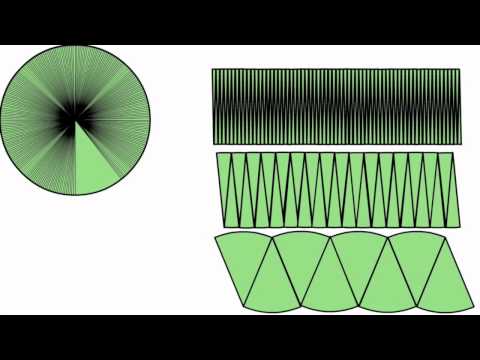
Area of a circle, formula explained
I made this with a lot of heart, and every purchase helps me keep creating. If you like what I do or just want to support independent ...
Conclusion: Mastering the Area of a Circle for Practical and Academic Success
Grasping the area de circulo formula opens the door to a wide range of practical applications and academic opportunities, making it a valuable skill for students, professionals, and everyday problem-solvers. By understanding how the radius influences the area and how to avoid common pitfalls, you can approach circular measurements with accuracy and confidence. The formula’s simplicity, A = π × r², masks its profound implications in science, engineering, art, and nature. As you continue to explore geometry, remember that this formula is not just a tool for exams but a fundamental principle that describes how space is organized in circular forms.
Whether you are calculating the size of a backyard pond, designing a circular logo, or studying advanced mathematics, the area de circulo formula remains a constant and reliable guide. Practice reinforces understanding, so keep applying the formula in different contexts to deepen your intuition. With patience and attention to detail, you will find that working with circles becomes intuitive and even enjoyable. Ultimately, mastering this formula empowers you to see the world in terms of shapes, patterns, and precise measurements, enriching both your analytical skills and your appreciation of the geometry that surrounds you.
