Sumário do Conteúdo
Eduardo Viveiros de Castro stands as one of the most influential anthropologists of his generation, reshaping debates on perspectivism, Amerindian thought, and the ethics of comparison in anthropology. His work challenges readers to rethink the boundaries between humanity, animality, and divinity, proposing that what we call nature is always already mediated by culture.
Intellectual Formation and Early Trajectory
Born in Rio de Janeiro in 1951, Eduardo Viveiros de Castro grew up immersed in the urban fabric of Brazil while absorbing stories and images of the Amazon from family and academic circles. His undergraduate studies in Social Anthropology at the Universidade de Brasília exposed him to structuralism and Marxism, but it was his doctoral research among the Kayapó that catalyzed a decisive shift toward the analysis of indigenous cosmologies. In the field, he confronted the limits of conventional ethnography, realizing that translating Amerindian categories into Western terms often flattened the very realities he sought to understand.
Under the intellectual mentorship of scholars such as Darcy Ribeiro and the broader currents of Brazilian social thought, Viveiros de Castro began to formulate questions about how persons, animals, and spirits inhabit overlapping existential worlds. Early publications focused on myth and ritual, yet they already signaled a deeper ambition: to rethink the category of the human not as a fixed essence but as a situated perspective. This formative period laid the groundwork for his later theoretical innovations, including perspectivism, multinaturalism, and the critique of ontological colonialism.
The Core Contribution: Perspectivism and Multinaturalism
At the heart of Viveiros de Castro’s oeuvre is the concept of perspectivism, inspired by Amerindian philosophies—especially those of the Amazonian societies he worked with—which assert that reality is always apprehended from a situated point of view. For him, perspectivism is not a relativist doctrine but a rigorous framework for understanding how different kinds of beings negotiate a shared world. Humans, jaguars, and spirits each have their own centers of experience, and what appears as one thing from one perspective can appear as something else from another, without collapsing into pure subjectivism.
Building on this, he developed multinaturalism as an alternative to the dominant universalist paradigms of social theory. In a multinaturalist view, there is not one nature but multiple natures, each coherent within its own cosmological frame. This move allows him to highlight the richness of Amerindian ontologies while also critiquing the way Western modernity imposes a single, flattened conception of the world. By foregrounding these contrasting yet equally valid perspectives, Viveiros de Castro invites readers to decenter their own standpoint and engage in a more dialogical anthropology.
Key Texts and Theoretical Landmarks
Among his most influential books, From the Enemy’s Point of View (1992) offers a meticulous analysis of Tupinambá perspectivism, demonstrating how kinship, warfare, and cosmology intertwine to produce a distinctive mode of being-in-the-world. In Cosmological Deixis and Amerindian Perspectivism (1998), he refines the notion of cosmological deixis, showing how pronouns and indexical expressions are not neutral markers but carriers of entire existential frameworks. These works established him as a leading voice in the anthropology of indigenous thought and opened pathways for dialogue with philosophy, science studies, and postcolonial theory.
Later, in pieces such as Perspectival Anthropology and the Method of Controlled Equivocation, Viveiros de Castro reflects on the ethical and political stakes of his methodological choices. He argues that effective collaboration with indigenous partners requires researchers to practice a kind of controlled equivocation—holding multiple translations in tension without reducing them to a single authoritative version. This stance not only enriches academic inquiry but also supports more just forms of knowledge production, where indigenous voices are not merely consulted but allowed to speak on their own terms.
Engagement with Contemporary Debates
In recent years, Eduardo Viveiros de Castro has extended perspectivism to address urgent questions about environmental crisis, technoscience, and global capitalism. He engages critically with the Anthropocene, suggesting that its narrative often overlooks the longue durée of human-nonhuman entanglements revealed by indigenous and ethnographic histories. For Viveiros de Castro, the crises of climate change and biodiversity loss are not simply external threats but symptoms of a broader cosmological imbalance rooted in colonial categories of nature and culture.
His interventions into debates about animism, new materialisms, and posthumanism emphasize that indigenous thought has long articulated a world where agency, intention, and sentience are distributed across humans, animals, plants, and spirits. By translating these ideas into contemporary theoretical languages, he bridges local Amazonian experiences with global philosophical conversations. This work resonates far beyond anthropology, informing fields such as science and technology studies, political ecology, and decolonial thought.
Methodological Innovations and Ethical Commitments
Viveiros de Castro’s methodological approach is distinguished by its commitment to rigorous comparison without assimilation. He insists on treating indigenous categories as full-fledged cosmologies rather than data points to be explained away by external theories. This requires a slow, patient form of fieldwork in which the researcher learns to navigate multiple realities without rushing to impose a univocal interpretation. His preference for long-term engagement, linguistic immersion, and collaborative writing reflects a deep respect for the communities with whom he works.
Ethically, his project is oriented toward de-colonizing knowledge production. He advocates for modes of research that recognize indigenous peoples as authors of their own representations, resisting the extractive dynamics that have long characterized academic engagement with marginalized groups. By foregrounding concepts like perspectivism and controlled equivocation, he offers tools not only for analysis but also for fostering more reciprocal and accountable relationships between researchers, indigenous partners, and broader publics.
Legacy and Ongoing Influence
The legacy of Eduardo Viveiros de Castro is evident in the proliferation of courses, reading groups, and research projects that take indigenous cosmologies seriously as sources of theoretical innovation. Younger scholars across anthropology, philosophy, and the humanities draw on his concepts to rethink questions of personhood, agency, and value in ways that move beyond Eurocentric assumptions. His insistence on the vitality of non-Western worlds continues to inspire new generations committed to intellectual pluralism and decolonial practice.
As debates over biodiversity, climate justice, and cultural survival intensify, the relevance of his work only grows. By showing how different perspectives can coexist without being flattened into a single narrative, Viveiros de Castro provides a vital resource for thinking together about life in times of crisis. His contributions remind us that the task of anthropology is not only to describe other worlds but also to transform the shared world we inhabit through more attentive and respectful forms of knowing.
Vídeos Relacionados
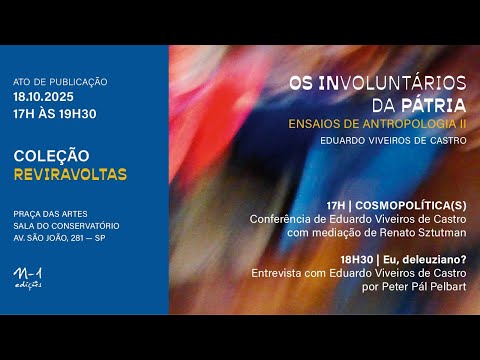
OS INVOLUNTÁRIOS DA PÁTRIA com Eduardo Viveiros de Castro
Ato de publicação do livro OS INVOLUNTÁRIOS DA PÁTRIA: Ensaios de antropologia II de EDUARDO VIVEIROS DE CASTRO, ...
Conclusion
Eduardo Viveiros de Castro has redefined the landscape of contemporary anthropology by centering indigenous perspectives, refining key concepts like perspectivism and multinaturalism, and engaging deeply with global theoretical and political questions. His work challenges us to see beyond the narrow confines of Western modernity, inviting a more plural and responsible encounter with the multiple natures that coexist on this planet. In continuing to read, teach, and apply his ideas, scholars and activists alike open themselves to new ways of thinking together across difference.
